Mentorship - for Better Future
In his introductory statement to the employees, Blaž Brodnjak explained: “We will continue to pay special attention to mentorship. Both inside and outside the Bank, we will continue to promote the awareness that NLB is the Bank with the most knowledge, experience, and expertise, as well as the bank with the most innovative and advanced solutions, an institution that truly pays attention to its clients and knows what they need, i.e. a bank that knows how to offer the right solution to its clients, at the right time and place. It is therefore essential that we continue to invest in knowledge, and upgrade and share it. We must develop innovative, but clear and simple solutions available to the clients when they need them, and in a manner closest to them. These must be solutions that guarantee a safe future, considering their financial situation. In all this, we have to be driven by responsibility – not only to the clients, but also to colleagues, society, the environment, and ourselves. This is the only way we will be able to become good mentors for our clients, and able to provide answers for all their present and future questions.”
Increasing Financial Literacy among young people
In addition to investing in its employees, the Bank also invests into the financial training of the wider society through the project ‘Financial Literacy for the Young.’
Investing in Tomorrow
Achievements in 2017

were provided with financial literacy.
secondary school teachers included in the Financial Literacy Project.
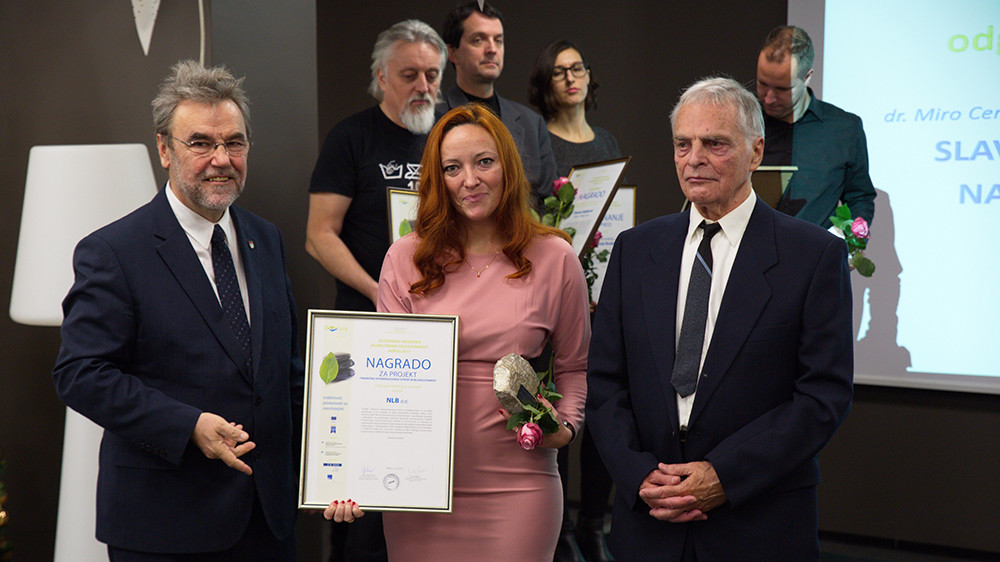
By organising financial literacy events, the Bank helps young people to understand finances, to achieve financial independence, and to act responsibly in the future. Therefore, it is very important that learning begins at a young age. The Bank introduced a holistic Financial Literacy Programme for children and teenagers, for which it received the Slovenian Horus Award for Social Responsibility for 2017.
The Horus Award is a part of a national awareness initiative meant to enhance the overall corporate social responsibility, with which the Slovenian Social Responsibility Development Institute and Public Relations Society of Slovenia wish to identify and reward the end-to-end approach employed by businesses and individuals to corporate social responsibility and sustainable development.

We are proud that our socially responsible activities are also recognised by the Institute for the Development of Social Responsibility and the Public Relations Society of Slovenia. All employees who participated in the financial literacy activities in the year that is now ending have made significant contributions to this year’s Horus award. A superb team of mobile bankers and other colleagues striving to transfer all their knowledge to the young people deserves the highest praise.
Alenka Rozman,
Head of Events, Social Responsibility, and Activation
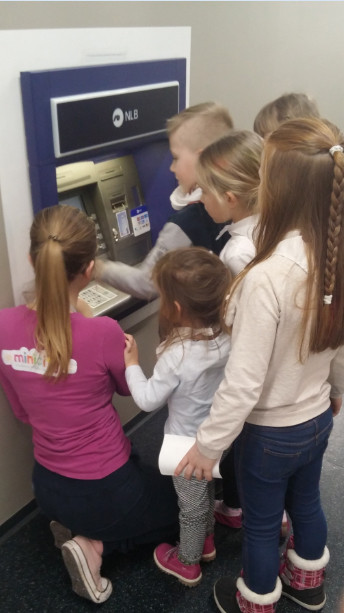
The Financial Literacy Programme is delivered to pre-school children, elementary school students, secondary school students, university students and secondary school teachers. Depending on the age and needs of children and young adults, a tailor-made programme with general and specific topics was created, due to the fact that such topics are hardly ever covered by the curriculum for Slovenian elementary and secondary schools. Through this tailor-made programme, bankers with many years of experience teach children how to enter the world of adults and how to monitor their financial status properly.
NLB approached the programme of financial literacy of children and young people by devising a complex project for educating children in all financial areas in different age groups. The financial literacy programme is carried out by experienced NLB coaches and lecturers or moderators. The project was delivered to more than 7,000 children, students, and secondary school teachers. The programme of financial literacy workshops includes different adjusted contents “Five steps to well-organised personal finances,” and “Easy finance,” depending on the age of the children.
The programme for pupils includes learning the basic information about the bank and its operations, the bank consultant profession, the opening of an account, handling of bank cards; the basics about money, its value, history, handling of money and recognising it, organisation, addition, logical deduction, differentiation; the money circle, earning of money, saving and planning of consumption, team work, memory training, logical deduction, money handling and social skills. Workshops were organised at primary schools in Rakek, Šoštanj, Luče, Radlje ob Dravi, Šmartno pri Slovenj Gradcu, Dravograd, Trebnje, Dolenjske toplice, Šentjernej, Mirna, Šentrupert, Mokronog, Šmarjeta, Krmelj, Boštanj, Šentjanž, Sevnica, Tržišče, Dobova, Krško, Lendava, Beltinci, Negova, Pirniče, Kočevje and Taborniški ZLET. A total of 3267 pupils participated.
he financial literacy programme for secondary school students presents financial independence to students. It shows the drafting of a financial plan and the basics of money management. They are presented the concepts of loan, overdraft, credit card payment (types of cards), and the fact that borrowed money must be repaid. They are also presented the forms of saving with a short calculation, savings account, gradual savings, deposits, mutual funds, and insurance. Special emphasis is put on the assurance of security in online operations and on the golden rules of money handling. The programme was carried out in the form of visits to secondary schools or inviting young people to attend lectures at the IEC (Innovative Entrepreneurship Centre). The following secondary schools participated in the programme: Secondary School for Food Processing, Ljubljana, Rudolf Maister Grammar and Secondary School Kamnik, Secondary School of Economics, Maribor, Kočevje Grammar and Secondary School, Secondary School of Economics, Ljubljana, Jesenice Secondary School, Postojna School Centre, Secondary School of Business and Economics Koper (SEPŠ), Zagorje Secondary School, SC PET
Secondary Schools Centre Ljubljana, and the Secondary School of Architecture. Besides that, we also support the project Financial Literacy for the young, organised by Moje finance magazine. A total of 2,271 secondary school students attended the lectures.
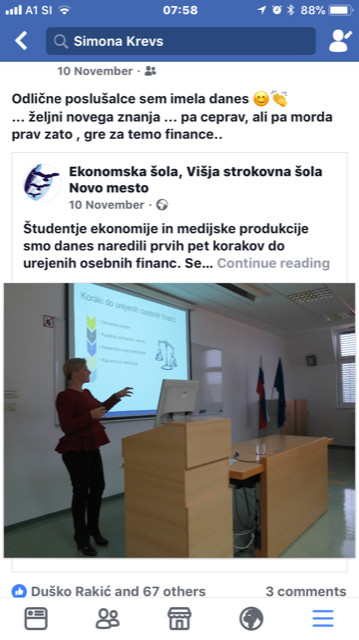
The purpose of the programme “Five steps to well-organised finance” is to explain to the students the meaning of personal finances, how to plan them, change them in a planned and systematic manner, take into account future events, and manage financial risks. They are presented the life cycle by connecting income, the structure of assets, the methods for regulating consumption, the care of financial security, the assurance of safety reserves, the methods of increasing assets, and planning for the future. They are shown the calculation for safety protection with sum insured, the calculation of pension reserves, and the reasons why we should start saving as soon as possible. The following faculties participated in the programme: Faculty of Management University of Primorska, ALUO UHO, Student Club Logatec, Faculty of Business, Management and Informatics Novo mesto, Higher Vocational College Novo mesto. The presentation of financial literacy in cooperation with different partners in the following projects: JA Slovenia, the IEC hosted the winners, Summer School of Cultural Management and AmCham, with the presentation of the basics of financial literacy, “Bytes of Banking” (in cooperation with Halcom and ESTECH) the IEC organised a workshop in the area of marketing, big data, and development of information technology and services. The students of economic and technical sciences built an online chatbot, ‘NLBotko’ which helps solve users’ problems. We improved the financial literacy of the students and obtained fresh ideas for banking services and IT development.
mobile financial consultant
Secondary school teachers
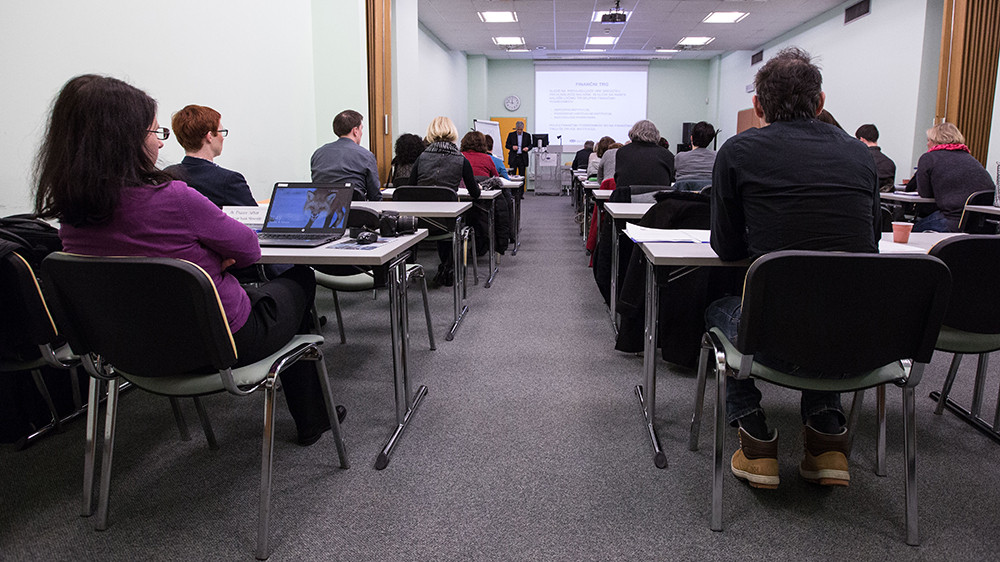
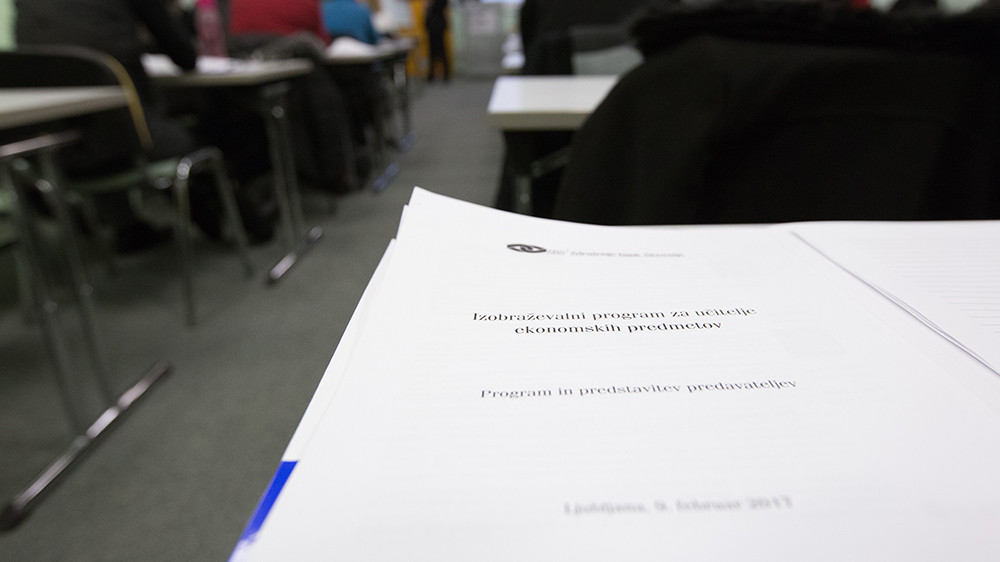
In cooperation with the project SPIRIT SLO, a Start-up for secondary school teachers, the latter were presented the basics of financial literacy. A total of 25 secondary school teachers attended the lecture.